
Payment Innovations in Online Casinos: How E-Wallets and Instant Withdrawals Are Transforming Digital Gaming

Online casinos have become testing grounds for cutting-edge payment technology that often surpasses what traditional banks offer. Players no longer accept slow withdrawals or limited payment options when they can access their winnings instantly through modern digital solutions.
Payment innovations in online casinos now include e-wallets, cryptocurrency transactions, and instant withdrawal systems that process payouts in minutes rather than days. These advances have transformed how players deposit funds and cash out their winnings, creating a faster and more secure gambling experience.
The shift from basic credit card payments to sophisticated digital wallets, blockchain transactions, and biometric authentication shows how the gambling industry drives financial technology forward. Understanding these payment methods helps players choose the fastest and most secure options for their online gaming activities.
The Evolution of Payment Methods in Online Casinos
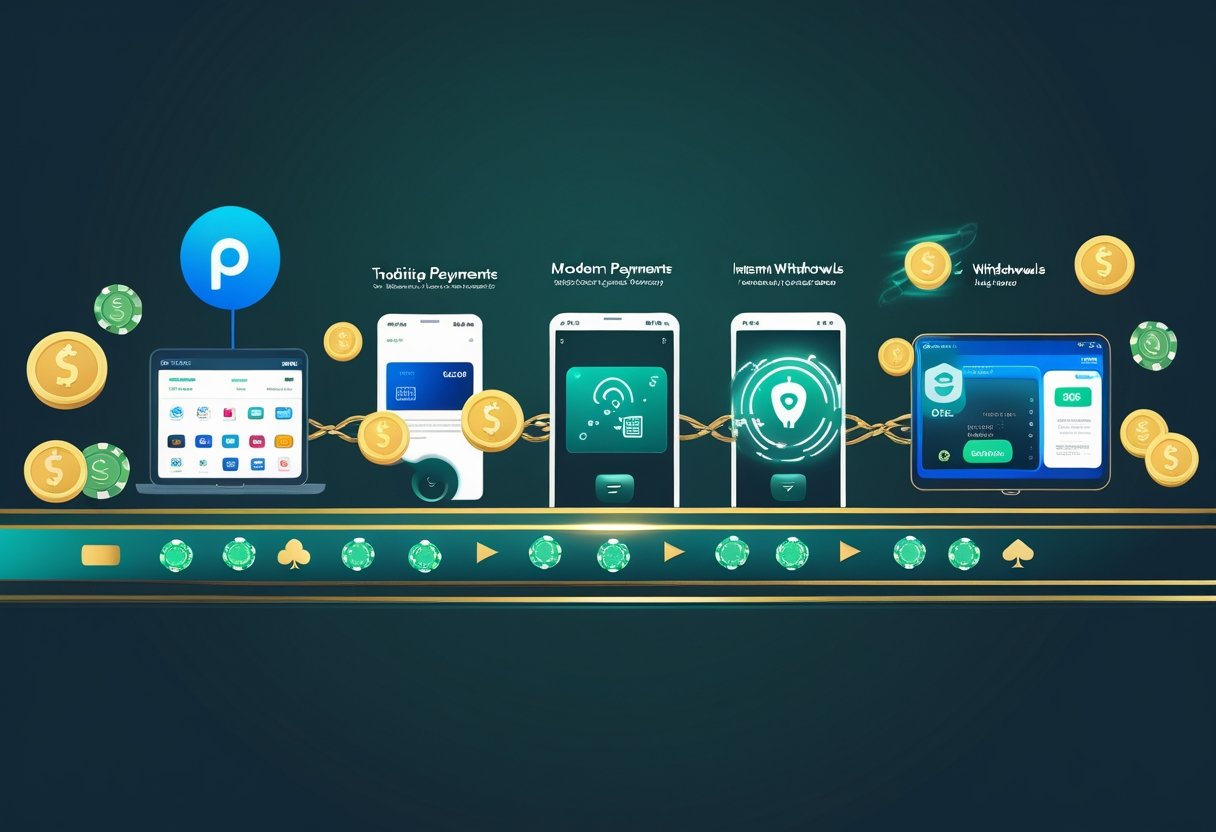
Online casino payment methods have transformed from basic credit card transactions in the 1990s to sophisticated digital systems that process millions of transactions daily. This shift reflects broader technological advances and changing player expectations for speed, security, and convenience.
Transition from Traditional to Digital Payments
Early online casinos in the mid-1990s relied heavily on credit cards and bank transfers. Players had limited options and often waited 3-7 business days for withdrawals to process.
Credit cards dominated the market but faced restrictions from banks. Many financial institutions began blocking gambling transactions due to regulatory concerns.
E-wallets emerged as game-changers in the early 2000s. PayPal, Neteller, and Skrill offered faster transactions and added privacy layers between players and casinos.
Digital wallets reduced processing times from days to hours. They also provided better fraud protection and allowed players to manage gambling budgets more effectively.
Prepaid cards gained popularity as another alternative. These cards let players deposit specific amounts without linking bank accounts directly to gambling sites.
Mobile payment solutions entered the scene around 2010. Apple Pay and Google Pay made deposits possible with just a fingerprint or face scan.
Key Milestones in Payment Technology
1996: First online casinos accept credit card payments through basic SSL encryption.
2001: E-wallet services launch, offering faster processing times and enhanced security features.
2009: Bitcoin creates new possibilities for anonymous, decentralized casino payments.
2014: Mobile payment integration becomes standard across major casino platforms.
2018: Instant withdrawal systems reduce processing times to under 60 minutes for digital payments.
2021: Cryptocurrency adoption accelerates, with over 40% of new online casinos accepting digital currencies.
The introduction of instant banking solutions like Trustly and Pay N Play revolutionized the user experience. These services connect directly to player bank accounts without requiring separate wallet registrations.
Blockchain technology brought transparency to payment processing. Smart contracts now automate payouts and ensure fair gaming practices.
Impact on Player Experience
Payment innovation directly correlates with player satisfaction and retention rates. Faster withdrawals reduce anxiety and build trust between players and operators.
Modern players expect deposits to appear instantly in their accounts. Delays of more than a few minutes often lead to abandoned gaming sessions.
Security improvements have made online gambling safer than ever. Two-factor authentication and biometric verification protect player funds from unauthorized access.
Payment diversity attracts different player demographics. Cryptocurrency options appeal to tech-savvy users, while traditional methods serve conservative players.
Lower transaction fees benefit both parties. Digital payment methods typically cost 2-5% less than credit card processing, allowing casinos to offer better bonuses.
The rise of micro-payments enabled new gaming formats. Players can now make deposits as small as $1, making gambling more accessible to casual users.
Regional payment preferences drive casino expansion. Operators now support local methods like Pix in Brazil and UPI in India to enter new markets effectively.
Understanding E-Wallets in iGaming

E-wallets have become a leading payment method in online casinos due to their speed and security features. These digital payment systems allow players to deposit funds instantly and withdraw winnings faster than traditional banking methods.
How E-Wallets Work for Casino Transactions
E-wallets act as a bridge between players’ bank accounts and casino sites. Players first load money into their e-wallet from a bank account or credit card.
Once the e-wallet contains funds, players can make instant deposits to casino accounts. The process takes seconds instead of the days required for bank transfers.
Deposit Process:
- Select e-wallet as payment method
- Enter deposit amount
- Log into e-wallet account
- Confirm transaction
- Funds appear immediately in casino account
Withdrawals work in reverse. Players request a withdrawal to their e-wallet, and the casino processes it. Most e-wallet withdrawals complete within 24 hours.
The e-wallet stores transaction history and balances. Players can track all their casino payments in one place. This makes money management easier for regular players.
Advantages of Using E-Wallets
Speed stands out as the biggest benefit. Deposits happen instantly, letting players start gaming right away. Withdrawals reach e-wallets much faster than bank accounts.
Enhanced security protects player information. E-wallets use encryption and don’t share banking details with casinos. Players only provide their e-wallet login credentials.
Privacy protection appeals to many users. Casino transactions appear as e-wallet payments on bank statements. This keeps gambling activity more private.
Lower fees make e-wallets cost-effective. Many e-wallet providers charge no fees for casino deposits. Even withdrawal fees are often lower than credit card charges.
Multi-currency support helps international players. E-wallets can hold different currencies and convert them automatically. This eliminates exchange rate confusion.
Popular E-Wallet Providers
PayPal leads the market with wide casino acceptance. It offers strong buyer protection and instant transactions. However, PayPal restricts gambling in some countries.
Skrill specializes in online gaming payments. It charges low fees and processes withdrawals quickly. Skrill also offers a prepaid card for easy fund access.
Neteller provides similar services to Skrill. It features competitive exchange rates for international players. Neteller also includes a loyalty program with cashback rewards.
ecoPayz focuses on secure transactions. It operates in over 180 countries and supports multiple currencies. The platform offers both virtual and physical cards.
Apple Pay and Google Pay work through mobile devices. These options provide biometric security through fingerprints or face recognition. However, fewer casinos accept these newer payment methods.
Cryptocurrency and Blockchain-Based Payments
Digital currencies like Bitcoin and Ethereum have transformed how players make deposits and withdrawals at online casinos. These blockchain-based systems offer faster transactions and stronger security than traditional banking methods.
Adoption of Bitcoin and Altcoins
Bitcoin remains the most widely accepted cryptocurrency at online casinos. Players can deposit and withdraw funds using Bitcoin at hundreds of gaming sites worldwide.
Many casinos now accept alternative cryptocurrencies beyond Bitcoin. Popular options include Ethereum, Litecoin, and Bitcoin Cash. These altcoins often process transactions faster than Bitcoin.
Dedicated crypto casinos have emerged that only accept digital currencies. These platforms eliminate traditional banking entirely. They focus on serving players who prefer anonymous transactions.
Some mainstream casinos offer hybrid payment systems. Players can choose between credit cards, e-wallets, or cryptocurrencies. This flexibility attracts both traditional and crypto-savvy players.
Benefits of Blockchain Security
Blockchain technology creates permanent transaction records that cannot be changed. Every deposit and withdrawal gets recorded on a public ledger. This transparency helps prevent fraud and disputes.
Smart contracts automate payment processes without human involvement. These programs execute withdrawals instantly when conditions are met. Players receive their winnings faster with fewer errors.
Provably fair gaming uses blockchain to verify game outcomes. Players can check if results were truly random. This builds trust between casinos and their customers.
Cryptocurrency transactions protect player privacy better than credit cards. Players only need a wallet address to make payments. Personal banking information stays private.
Managing Volatility and Transaction Speed
Bitcoin prices can change rapidly during the day. A $100 deposit might be worth $90 or $110 within hours. Some casinos convert crypto deposits to stable currencies immediately.
Stablecoins like USDC and Tether solve volatility problems. These cryptocurrencies maintain steady values tied to the US dollar. Players avoid price swings while keeping crypto benefits.
Transaction speeds vary between different cryptocurrencies. Bitcoin transactions can take 30-60 minutes to confirm. Newer cryptocurrencies like Solana process payments in seconds.
Network congestion affects transaction fees and speed. During busy periods, Bitcoin fees can reach $20 per transaction. Alternative cryptocurrencies often maintain lower costs.
Instant Withdrawals: Speeding Up Payouts
Modern online casinos process withdrawals within minutes using automated systems and advanced payment networks. E-wallets and cryptocurrencies enable the fastest transactions, while verification requirements create processing delays.
How Instant Withdrawal Mechanisms Operate
Instant withdrawal systems rely on automated processing networks that eliminate manual review steps. These systems connect directly to payment processors and banking networks.
The fastest platforms process digital wallet withdrawals within 1-6 hours. Traditional bank transfers still require 1-3 business days due to banking system limitations.
Key Components of Instant Systems:
- Automated approval algorithms
- Real-time payment network integration
- Pre-verified player accounts
- Digital payment gateway connections
Casino operators use artificial intelligence to detect fraud patterns automatically. This removes the need for human review in most withdrawal requests.
Players must complete initial verification before accessing instant withdrawals. Once verified, the system processes future requests without delays.

Payment Solutions Enabling Fast Withdrawals
E-wallets provide the fastest withdrawal speeds among all payment methods. PayPal, Skrill, and Neteller typically process transactions within minutes.
Cryptocurrencies offer near-instant transfers with minimal fees. Bitcoin and Ethereum withdrawals complete within 10-30 minutes depending on network conditions.
Payment Method Speed Comparison:
| Method | Processing Time | Availability |
|---|---|---|
| E-wallets | 0-30 minutes | Most casinos |
| Cryptocurrency | 10-30 minutes | Limited casinos |
| Debit cards | 1-3 hours | Common |
| Bank transfers | 1-3 days | Universal |
Digital banking solutions enable instant bank-to-bank transfers in some regions. Open banking technology connects casino accounts directly to player bank accounts.
Credit cards cannot receive instant withdrawals due to card network policies. Players must use alternative methods for fast payouts.
Verification and Compliance Challenges
Anti-money laundering regulations require identity verification before processing withdrawals. Players must submit government-issued identification and proof of address.
Initial verification takes 24-72 hours to complete. This creates delays for new players seeking immediate withdrawals.
Required Verification Documents:
- Photo identification (driver’s license or passport)
- Proof of address (utility bill or bank statement)
- Payment method verification (card photos or bank statements)
Compliance systems flag unusual withdrawal patterns for manual review. Large withdrawals or frequent requests trigger additional security checks.
Players can speed up verification by submitting clear document photos. Blurry or incomplete documents cause processing delays.
Some casinos offer limited withdrawals before full verification. These temporary limits allow small payouts while documents are under review.
Mobile Payment Platforms in Online Gambling
Mobile devices have become the main way people access online casinos today. Players can now use their phones to make quick payments through digital wallets, tap-to-pay systems, and apps designed specifically for mobile gambling.
Integration of Mobile Wallets
Mobile wallets like Apple Pay, Google Pay, and Samsung Pay are now standard at most online casinos. These apps store payment card information securely on phones and tablets.
Players can link multiple payment methods to one mobile wallet. This includes credit cards, debit cards, and bank accounts. The wallet acts as a middle layer between the casino and the player’s actual payment method.
Popular Mobile Wallet Features:
- Biometric security (fingerprint, face ID)
- One-touch payments
- Transaction history tracking
- Multiple currency support
- Instant deposit processing
Most mobile wallets use tokenization technology. This means the actual card numbers are never shared with the casino. Instead, the wallet creates a unique code for each transaction.
Casino apps can integrate mobile wallets through APIs. This allows players to make deposits without typing in card details every time.
Contactless Payments in Casinos
Contactless payment technology has moved from physical stores to online gambling platforms. Players can now use NFC (Near Field Communication) enabled devices to make payments.
This technology works by holding a phone or smart device near a payment terminal. The payment processes in seconds without entering passwords or PINs.
Benefits of Contactless Payments:
- Faster transaction times (2-3 seconds)
- Reduced fraud risk
- No physical card needed
- Works with wearable devices
- Automatic receipt generation
Many online casinos now support contactless payments through their mobile apps. Players can deposit funds by simply tapping their phone on compatible payment readers.
Some casinos have introduced QR code payments. Players scan a code with their phone camera to complete transactions instantly.
User Experience on Mobile Devices
Mobile payment platforms focus heavily on making transactions simple and fast. The average mobile casino payment takes less than 30 seconds to complete.
Mobile Payment Interface Features:
- Large, easy-to-tap buttons
- Simplified forms with auto-fill
- Voice-activated payments
- Dark mode options
- One-handed operation design
Most casino apps remember payment preferences. Players can set default amounts, payment methods, and security settings. This reduces the steps needed for future transactions.
Mobile payments often include real-time notifications. Players get instant alerts when deposits are processed or withdrawals are approved.
The mobile interface typically shows payment limits clearly. Players can see daily, weekly, and monthly spending limits before making deposits. This helps with responsible gambling practices.
Many platforms now offer progressive web apps instead of native apps. These work directly through mobile browsers while still providing fast payment processing.
Biometric Payment Authentication
Biometric payment systems use unique physical features like fingerprints and facial recognition to verify player identity during casino transactions. These methods provide stronger security than traditional passwords while making the payment process faster and more convenient.
Fingerprint and Facial Recognition
Fingerprint scanning has become the most common biometric method in online casino payments. Players can complete transactions by placing their finger on a scanner or touching their mobile screen. The technology reads unique ridge patterns that are nearly impossible to replicate.
Facial recognition systems use cameras to map distinctive facial features. The software measures distances between eyes, nose, and mouth to create a unique digital signature. Most modern smartphones and tablets include built-in facial recognition capabilities.
Mobile casino apps benefit most from these technologies. Players can deposit funds or withdraw winnings without typing passwords or security codes. The authentication happens in seconds, making the gaming experience smoother.
Some casinos combine both methods for extra protection. Players might use fingerprint scanning for deposits and facial recognition for larger withdrawals. This layered approach reduces fraud risk significantly.
Enhancing Security with Biometrics
Biometric authentication eliminates many security problems that plague traditional payment methods. Stolen passwords cannot compromise accounts when fingerprints or facial scans are required. Hackers cannot easily replicate these biological features.
The technology also prevents account sharing between players. Each person’s biometric data is unique and cannot be transferred to others. This helps casinos maintain compliance with gambling regulations.
Real-time verification stops fraudulent transactions before they complete. The system immediately flags attempts to use fake or stolen biometric data. This protects both players and casino operators from financial losses.
Biometric systems create detailed audit trails for every transaction. Regulators can track exactly who authorized each payment, when it occurred, and which device was used. This transparency builds trust with licensing authorities.
Prepaid and Voucher-Based Solutions
Prepaid cards and voucher systems offer players anonymous payment options without linking bank accounts or credit cards. These methods work through purchase codes and prepaid balances that fund casino accounts instantly.
How Prepaid Cards Work Online
Prepaid cards function like gift cards for online casino payments. Players buy these cards from retail stores or online vendors with predetermined amounts.
The cards contain unique codes or numbers. Players enter these codes on casino payment pages to transfer funds instantly.
Popular prepaid card types include:
- Paysafecard vouchers
- Neosurf prepaid cards
- Flexepin vouchers
- AstroPay cards
Most prepaid cards work in denominations from $10 to $100. Players cannot reload expired cards or recover unused balances in most cases.
The main advantage is complete privacy. No personal banking information gets shared with casinos. This appeals to players who want anonymous gaming experiences.
Popular Voucher Systems
Paysafecard leads the voucher payment market globally. Players buy 16-digit PIN codes from authorized retailers in over 40 countries.
The system works through a simple code entry process. Players type their PIN on the casino payment page and funds transfer immediately.
Other major voucher systems include:
- Neosurf: Available in Europe and Australia
- Flexepin: Popular in Canada and Australia
- Cashlib: Growing presence in European markets
These vouchers typically charge small fees between 2-5% of transaction amounts. Most expire within 12 months if unused.
Players can combine multiple vouchers for larger deposits. This flexibility helps accommodate different betting budgets and gaming preferences.
Open Banking and Direct Bank Transfers
Open banking technology transforms how players move money to and from online casinos by connecting bank accounts directly to gaming platforms. This shift eliminates traditional payment barriers and creates faster, cheaper transactions for both operators and players.
Faster Payments Through Open Banking
Open banking turns slow bank transfers into instant transactions. Traditional bank transfers used to take 3-5 business days to complete. Now they clear in seconds.
The technology works through secure APIs that connect banks directly to casino platforms. Players can authorize payments without entering card details or using third-party services.
Key speed improvements include:
- Deposits process in under 30 seconds
- Withdrawals complete within minutes
- No waiting for card authorization
- Real-time transaction confirmation
This speed matters most for withdrawals. Players expect quick access to their winnings. Instant payouts keep customers happy and reduce support requests.
The system also handles large transactions better than cards. Credit cards often block big casino deposits. Bank transfers have higher limits and fewer restrictions.
Reducing Transaction Fees
Open banking cuts payment costs significantly compared to traditional methods. Card payments typically charge 2-4% per transaction. Bank transfers through open banking cost much less.
Cost comparison breakdown:
- Credit cards: 2.5-3.5% per transaction
- E-wallets: 1.5-2.5% per transaction
- Open banking transfers: 0.1-0.5% per transaction
These savings add up quickly for high-volume players. A player depositing $1,000 saves $20-30 per transaction compared to card payments.
Casinos pass some savings to players through better bonuses and lower minimum deposits. Reduced processing costs mean operators can offer more competitive rewards.
The technology also eliminates chargeback fees. Bank transfers are final and cannot be reversed like credit card payments. This protects operators from fraud-related losses.
Payment Innovation and Responsible Gambling
New payment technologies help casinos set better spending controls and track player behavior. Regulators are updating rules to match these changes in how players deposit and withdraw money.
Deposit Limits and Payment Controls
Modern payment systems let casinos set automatic spending limits that work across all deposit methods. Players can set daily, weekly, or monthly caps that apply to credit cards, e-wallets, and bank transfers.
E-wallets like PayPal and Skrill now share spending data with casino operators. This helps casinos track how much players deposit from different sources.
Real-time monitoring systems flag unusual spending patterns. If a player suddenly increases their deposits by 300%, the system can trigger a cooling-off period.
Many casinos now offer instant deposit blocks. Players can freeze their ability to add money for set time periods. These blocks work even when players try to use new payment methods.
Payment processors also provide velocity controls. These limit how many transactions players can make per hour or day. Some systems require extra verification for deposits over certain amounts.
Regulatory Updates Impacting Transactions
The Payment Services Directive 2 in Europe requires stronger customer authentication for online payments over €30. This means casino players must verify transactions through their phones or apps.
New Know Your Customer rules require casinos to verify the source of funds for large deposits. Players may need to show bank statements for deposits over $3,000.
Several states are introducing real-time transaction reporting. Casinos must send deposit and withdrawal data to regulators within minutes of each transaction.
Open Banking regulations let regulators access player banking data directly. This helps them spot problem gambling patterns across multiple casino sites.
The Bank Secrecy Act now covers some cryptocurrency transactions at casinos. Operators must report crypto deposits over $10,000 to federal authorities.
Future Trends in Online Casino Payments
Artificial intelligence is transforming how payments get processed, while new fintech companies are creating faster and safer ways to move money. These changes will make casino transactions smoother and more secure for players.
AI and Machine Learning in Payment Processing
AI systems now watch transactions in real time to spot fraud before it happens. These smart programs learn from millions of payment patterns to catch suspicious activity faster than humans ever could.
Machine learning helps casinos process payments more quickly. The technology can predict which transactions might fail and route them through different systems automatically.
Smart fraud detection uses AI to analyze:
- Player spending habits
- Login locations and times
- Device fingerprints
- Transaction amounts and frequency
Payment processors are using AI to reduce false declines. When legitimate transactions get rejected by mistake, players get frustrated and may leave the casino.
AI also helps with instant risk assessment. The system can approve or deny transactions in milliseconds based on hundreds of data points about each player and their payment history.
Some casinos now use chatbots powered by AI to help players with payment issues. These bots can solve common problems like failed deposits or explain withdrawal timeframes without human help.
Emerging Fintech Solutions
New payment companies are building systems designed specifically for gaming. These fintech solutions focus on speed, lower fees, and better user experience than traditional banks.
Buy now, pay later services are starting to appear at some casinos. Players can make deposits and pay them back over time, though this raises concerns about responsible gambling.
Instant settlement networks allow casinos to process withdrawals in seconds instead of days. These systems bypass traditional banking delays by using direct connections between financial institutions.
Biometric payments are being tested at some online casinos. Players can authorize transactions using fingerprints or face recognition instead of passwords or PINs.
Regional payment solutions are growing fast. Companies create payment methods that work better in specific countries, offering local bank connections and familiar interfaces for players.
Some fintech firms now offer payment orchestration platforms. These systems automatically choose the best payment method for each transaction based on success rates, fees, and speed.
Frequently Asked Questions
Players often have specific questions about payment speed, security, and available options when choosing how to fund their casino accounts. Understanding the differences between payment methods helps players make better decisions about deposits and withdrawals.
Which electronic payment systems ensure the quickest payouts in online gambling?
E-wallets like PayPal, Skrill, and Neteller provide the fastest withdrawal times. These services typically process payouts within 24 hours or less.
Cryptocurrency withdrawals also offer quick processing times. Bitcoin and other digital currencies can complete transactions in minutes to a few hours.
Traditional bank transfers take the longest time. Players may wait 3-5 business days for these withdrawals to complete.
Credit and debit card withdrawals fall in the middle range. Most card withdrawals take 1-3 business days to reach player accounts.
Are there any advantages to using cryptocurrencies for casino transactions?
Cryptocurrencies offer enhanced privacy compared to traditional payment methods. Players can make transactions without sharing personal banking information.
Transaction fees are often lower with cryptocurrency payments. Many digital currencies charge minimal fees compared to credit cards or e-wallets.
Blockchain technology provides transparent and secure transactions. All cryptocurrency transactions are recorded on an unchangeable public ledger.
Processing speeds are typically faster than traditional banking methods. Most crypto transactions complete within minutes rather than days.
Some casinos offer special bonuses for cryptocurrency users. These promotions may include higher deposit bonuses or exclusive rewards.
What security measures do online casinos implement for payment safety?
Licensed casinos use SSL encryption to protect payment data. This technology scrambles sensitive information during transmission between players and casinos.
Two-factor authentication adds an extra security layer. Players must verify their identity through a second method like phone or email verification.
Fraud detection systems monitor transactions for suspicious activity. These systems can flag unusual spending patterns or unauthorized access attempts.
Casinos separate player funds from operational money. This practice protects player deposits even if the casino faces financial difficulties.
Regular security audits ensure payment systems meet industry standards. Independent companies test casino security measures and payment processing.
How do mobile payment options compare to traditional methods in online casinos?
Mobile wallets like Apple Pay and Google Pay offer convenient one-touch payments. Players can deposit funds quickly using biometric authentication on their phones.
Mobile payment apps often include built-in security features. These may include device-specific encryption and automatic fraud monitoring.
Traditional methods like bank transfers provide higher transaction limits. Players can typically deposit and withdraw larger amounts using conventional banking.
Mobile payments may have lower daily limits compared to credit cards. This restriction can affect high-stakes players who need larger transaction amounts.
Processing speeds vary between mobile and traditional options. Mobile wallets usually match e-wallet speeds while bank transfers remain slower.
Can payment methods affect bonus eligibility or promotional offers in online casinos?
Some casinos exclude certain payment methods from bonus offers. Skrill and Neteller deposits commonly do not qualify for welcome bonuses.
Credit card deposits usually qualify for all promotional offers. Most casinos accept card payments for bonus eligibility without restrictions.
Cryptocurrency users may receive special bonus terms. Some casinos offer enhanced bonuses or exclusive promotions for crypto deposits.
Prepaid cards and vouchers typically qualify for standard bonuses. These payment methods are treated the same as credit card deposits for promotions.
Players should check bonus terms before making deposits. Each casino lists which payment methods qualify for specific promotional offers.
What developments are shaping the future of payment processing in the online gaming industry?
Instant payment systems are becoming more common across casinos. These systems allow real-time deposits and withdrawals without traditional banking delays.
Central bank digital currencies may change how players make transactions. These government-backed digital currencies could offer new payment options.
Biometric authentication is expanding beyond mobile devices. Casinos are exploring fingerprint and facial recognition for payment verification.
Artificial intelligence improves fraud detection capabilities. AI systems can identify suspicious transactions more accurately than traditional methods.
Integration with social media platforms is growing. Some casinos now accept payments through popular social networks and messaging apps.